
Reading lift and confidence
The standard verdict band shows lift and confidence. It is what a run at Standard or Medium rigor reports, where the lift is an estimated lift. Experiments run at High rigor or above in Two URLs mode report a measured lift: the result is labeled Village conversion lift and uses recorded conversion evidence and sampling intervals instead of a confidence meter. See Conversion-evidence results.
The sections below describe the standard verdict. Lift is how much the variant changed the conversion rate; confidence describes the strength of the verdict.
Estimated or measured?
The rigor level you pick in the wizard decides which kind of lift you get. The wizard shows the method under the Rigor slider and in the Method cell of Review & run before you launch.
- Estimated lift (Standard and Medium). Squoosh's AI reviewer compares the two pages and grounds its read in what these shoppers did. It is a directional read, not a statistically conclusive result. This is the standard verdict described on this page.
- Measured lift (High and above, Two URLs). Squoosh counts verified conversions on each page across paired synthetic shoppers and reports the difference with a 95% sampling interval. There is no confidence meter and no reviewer override. The interval is wide at High (about ±27 percentage points) and narrows at higher levels, so the run can come back with no clear winner, and it measures synthetic shoppers, not your customers.
The vendor and feature-flag variant modes and demo workspaces report an estimated lift at every size.
Lift
Lift is the difference between the variant and the original on your goal, as a relative percent. A lift of +22% means the variant converted 22% more often than the original. A negative lift means it converted less.
Under the lift, Squoosh shows a 95% CI — a range like +6% → +37%. This range describes sampling uncertainty under the calculation's assumptions. A narrow range means a more precise estimate; a wide range means less certainty about the size of the effect. It does not establish how closely synthetic results match human-customer behavior.
What the lift measures
The lift is the relative difference in conversion between your two shopper groups — how much more (or less) often the variant's shoppers converted than the original's. It is the shoppers' measured result, shown on the same scale as the per-arm rates in the evidence table, so the headline reconciles with the numbers below it. Squoosh does not discount or scale the number down.
The 95% CI under the lift is derived from the paired shopper decisions themselves — it bounds that measured lift and is never re-centered onto the headline. A wider range on a small sample is honest uncertainty about the exact size, not a hidden adjustment to the number.
Note
Sometimes the lift shows a 95% CI of —. This happens when the headline reflects the reviewer's judgment of the change rather than the raw shopper rate, where a numeric range wouldn't describe the figure. The lift is still meaningful; it isn't a measured rate with an interval.
Confidence
Confidence is how sure Squoosh is that the result is real and not random noise. Higher is more certain.
Squoosh calls a winner at 80% confidence. The meter shows your result against the 80% mark, so you can see how decisively the winner cleared the bar. Confidence is capped at 98% — Squoosh never claims to be completely certain.
There is one confidence figure per experiment: how sure Squoosh is about the winner versus the original. You won't see a separate confidence for each version, because the question a verdict answers is whether one beat the other.
For more on why the bar is 80% and how to reach higher certainty, see How Squoosh decides a winner.
Lift by segment
The evidence section breaks the lift down by audience segment, with a bar for each segment's change versus the original. A change can help one segment and hurt another — for example, +12% for returning shoppers and −8% for first-time visitors. The per-segment numbers blend back to the single headline lift, so use them to understand who a change worked for, not as separate verdicts.
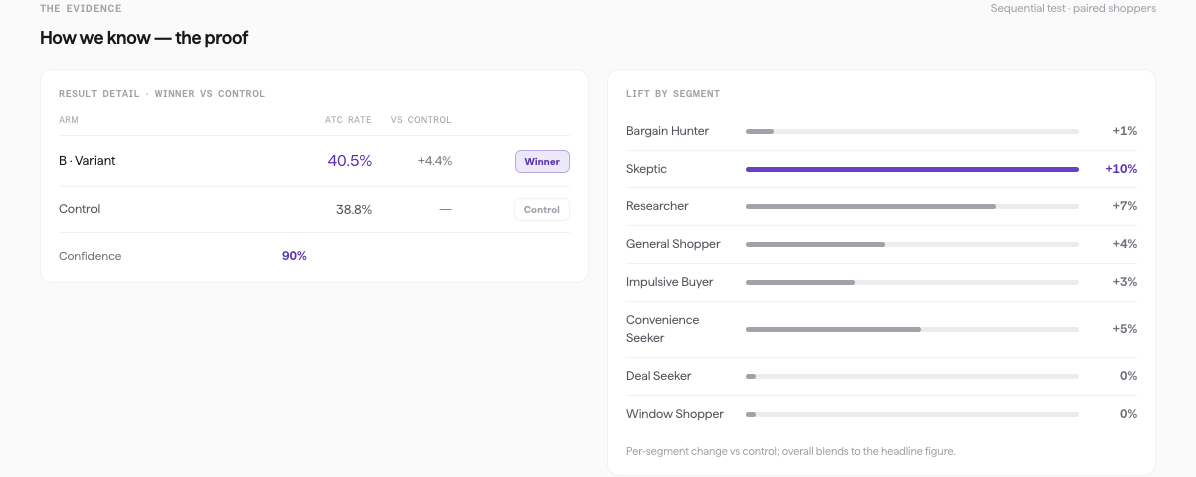
The evidence section — arm conversion rates and confidence on the left, lift broken down by segment on the right.